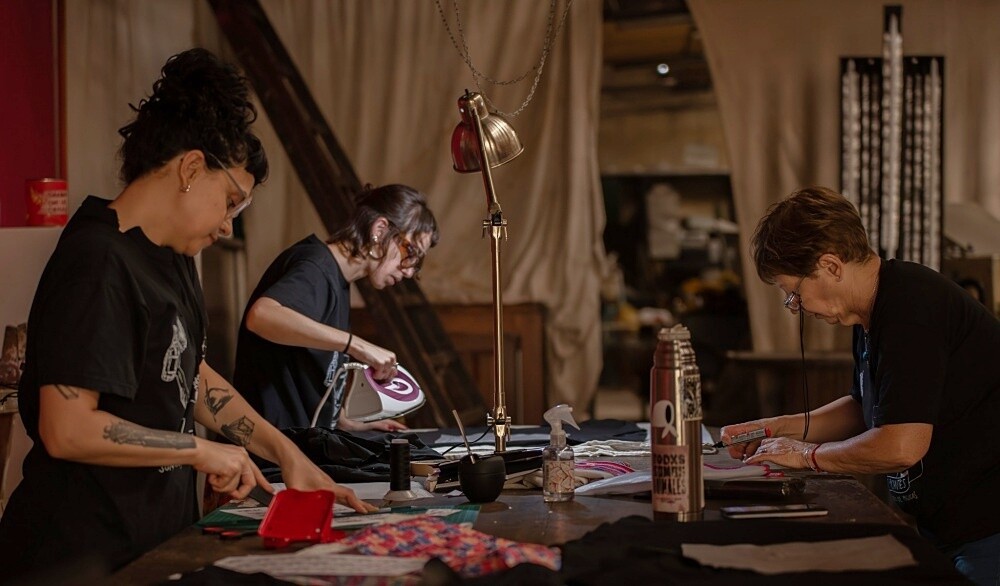
In the Nueva Pompeya neighborhood of Buenos Aires, the workday begins at ten in the morning. Fabrics, an iron, and a pile of t-shirts to be stamped with Norma Plá's portrait gradually appear. 'La Picante' is a small, emerging space for graphic exploration that uses art and graphic media in any format to test actions in the public sphere, both on the street and in the digital realm. Its purpose is to strengthen horizontal ties and weave networks to unify struggles. As the network is alive and constantly expanding, they are now embarking on a new adventure: organizing a fierce, spicy, and solidarity raffle for the roof repairs of a community dining hall. The initiative has activated a great chain of solidarity; photojournalists, printers, and friendly projects have donated artworks, books, and objects to assemble the prizes. For those who don't know the project yet, the invitation is clear: come to the plaza on Wednesdays, let's get 'picante' together. Those who want to collaborate can buy raffle tickets: 1 ticket: 3000 pesos, 2 tickets: 5000 pesos. To participate, you must contact 'Colectiva La Picante' on WhatsApp. The collective also likes to think that the t-shirt functions as an invitation to approach. In the images, there are traces and survivals, scenes that repeat and reinvent themselves. In each delivery, hugs, care, and complicity circulate. They circulate through the plaza, the province, and even reached Chile, Germany, France, and Spain. The growth led them to rethink techniques and times, although they want to preserve the artisanal character of the project: each t-shirt is washed, ironed, stamped, labeled by hand, and stored scented in its bag. It is moving the body and the word with humor, spark, and courage; opening a margin for play even in hostile scenarios. It is not about the material, but about demonstrating endurance: it doesn't matter how much money you have in your pocket, the t-shirt arrives. A raffle for Olga's dining hall roof. One of the 'picantes' is the compañera Olguita, who with love and daily work sustains the community dining hall 'La Kasa del Pueblo'. That irreverent spark is what inspires the collective. In the plaza today, one of the 'picantes' walks a pepper tied to a string in front of the police line. They use her image, and at the same time, imagine her using her own 'picante'. The operation dialogues with her history and her wit. In the plaza, when another 'picante' appears, a smile, a conversation, a dance is activated: a network is formed. On the scale they handle, it allows for quick recognition, knowing that there is a body willing to accompany if something happens. The collective takes that sign and inverts it: 'picante' is no longer just pepper spray or an excessive operation; 'picante' is on their side. 'Picantear,' then, is a verb, a living action. 'Picantear' is to project collectively, to explore new political imaginings. When the State abandons and only offers violence, the response is community. How the t-shirts work. Each person who buys a t-shirt finances another for each retiree. Today they count on the complicity of their comrades from the Chilavert Printing Cooperative, who lend them a space to iron and speed up the process. Going through the plaza giving away t-shirts is a way to interrupt the agenda that hands out batons and gas. A place traversed by the history of self-management and labor struggles. There couldn't be a better setting for what's happening: stamping t-shirts with an as emblematic image as Norma Plá's. A forceful gesture: we are planted here, no one gives up. In those raised arms, the effervescence of the murga and the party, the power of the hug, the joy of the encounter, and also the raised voice of the circle demanding justice for Pablo Grillo coexist. The solidarity wheel is what sustains the project. In this way, those who cannot come to the plaza on Wednesdays—due to work, distance, or fear—find a concrete way to accompany. This is how they awaited me to start their day, and I for my photos. The meeting is at the Chilavert Printing Cooperative, the historic printing recovered by its workers in 2002. That is where the bet lies: to build a critical stance against hegemonic images and narratives of revictimization that present retirees as 'poor old people,' to the detriment of their power as a combative political subject. That's what they're about, and they're not going to stop. The T-shirts. The chosen stamp is that of Norma Plá, a figure who is part of the popular imaginary that spans generations. It is born from the sustained experience of inhabiting the plaza of the retirees, where collective action began to take shape. It doesn't function as a rigid structure, but as an open and porous space that organizes itself from practice. Showing only those scenes feeds fear and helps to naturalize the idea that the right to protest no longer exists. Through t-shirts, posters, graphic pieces, and a photo-book currently in process, they propose to show another scene: that of minimal and powerful gestures, hugs, laughter, dances, and the creativity deployed to face the security forces. A plaza that does not exhaust itself in the public space, but expands to the domestic and strengthens networks of care. With some cumbias in the background, a little dancing, jokes, and laughter, they begin to stamp. Among machines, papers, and books, the space continues to function today as a print shop, cultural center, and popular high school for adults. But it's not just about an image: what interests them is her gesture. They seek to contribute to the construction of 'commons,' to potentiate the artistic and activist actions that already exist in the plaza and to generate alliances with other collectives, self-managed spaces, and independent groups. The Political Sense. The collective also seeks to dispute the image that hegemonic media construct about the retirees' struggle. In that gesture, they find a way to write in the plural. The stamp also includes a wink: in this version, the phrase 'jubilados picantes' (spicy retirees) appears, and Norma wears a chili pepper on her own t-shirt. And when it appears outside the plaza—on the street, in a reel—the magic expands: even in anonymity, they are still there. It is to challenge fear, to sustain protest as a right, and to activate a collective memory of struggles that precede us. 'After so much gas, I became spicy.' It is, in the end, about putting into circulation other images, other words. In that frame, the idea of 'picantes' appears. The initial idea was to make a small run for friends, but more than 150 have already been sold. The raised arms, the expanded body, occupying space, saying 'I'm here,' 'we're here.' On the table appear the mate, some chipá, Paraguayan soup, and some fruit. Many remember when he hung a chorizo in front of Cavallo's house. It is also possible to collaborate with time and work: self-management is built with many hands. The t-shirts are produced by DDT printing and a domestic iron. Although they play a key role in visualizing the repression and institutional violence that occurs every Wednesday at the Plaza del Congreso, the almost exclusive circulation of those scenes works as a double-edged sword. On the one hand, it enables a necessary denunciation; on the other, it contributes to the disciplining that the anti-picket protocol seeks to impose. In those images and graphics, they recognize a fundamental political force. Today, strategies of collective care are key tools to face disciplining in a context of neofascist advance. There is no margin for profit or entrepreneurial spirit. They defend that manual doing because each shared day is also a space for encounter: they work, laugh, and dance cumbia. In the street jargon, 'irse a picar' alludes to the tension, the imminence of repression, to being on alert. A small temporal mismatch, an ironic twist. Myrian, Sara, and Xime arrange their things on a large table. The graphic collective born from the heat of the retirees' rounds in front of Congress promotes a solidarity raffle to fix the roof of a community dining hall. The logic is simple and circular: the price exclusively covers the production cost of two garments.