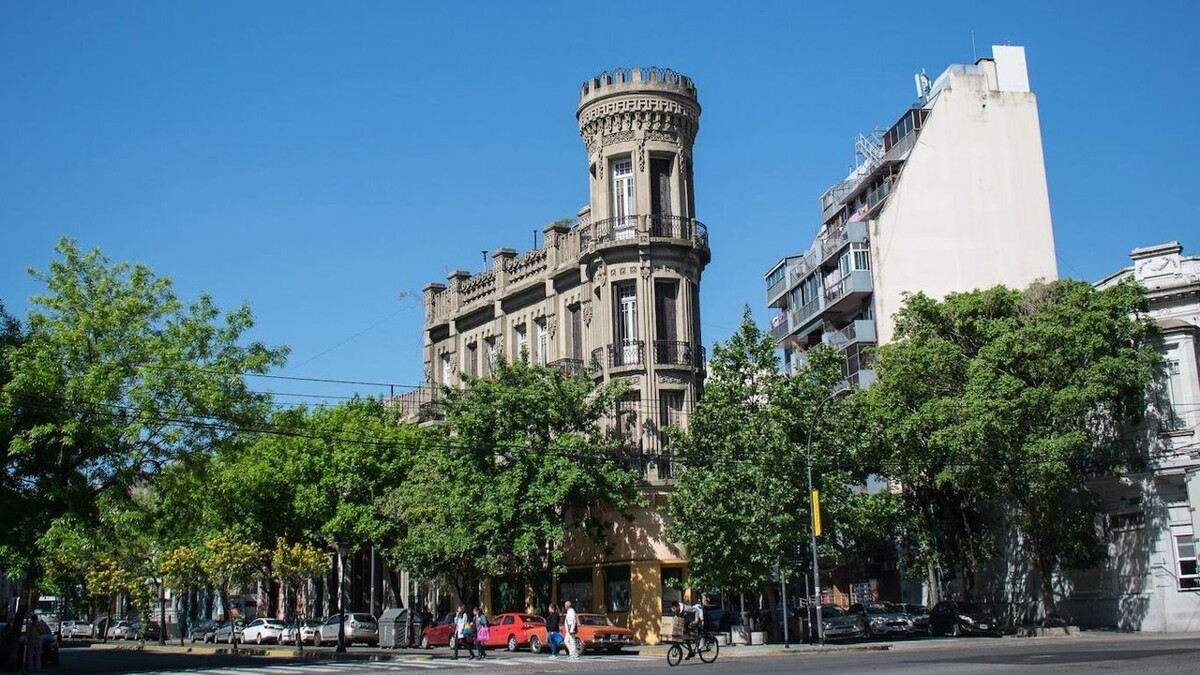
The Ghost Tower remains alive in the Porteño imagination, as a building where history and legend intersect and defy the passage of time.
In a discreet but mysterious corner of the La Boca neighborhood, a construction has stood for over a century, fueling one of the most unsettling urban legends in Buenos Aires. It is the famous Ghost Tower, a building of Catalan Modernist inspiration whose history combines wealth, art, and supposed supernatural phenomena.
The building was erected in the 1910s under the direction of Spanish architect Guillermo Álvarez Pérez, who left his mark on various corners of the city and is also the author of the famous Arc Building in the Constitución neighborhood. The project was commissioned by María Luisa Auvert Aurnaud, one of the wealthiest landowners in early 20th-century Argentina. Originally, it was intended as a rental building, but the magnitude and refinement of the work led its owner to move in there with her staff.
The tower, located at the intersection of Almirante Brown, Wenceslao Villafañe, and Benito Pérez Galdós streets, was decorated with furniture and details brought from Spain, especially Catalonia. The balconies were filled with exotic plants, including mushrooms known for their hallucinogenic properties—a fact that would later become central to the myth's construction.
Over time, events began to occur that caused unease among the staff. According to accounts circulating in the neighborhood, screams, blows, and unexplained noises were heard at night. One by one, the workers abandoned the place, until Auvert herself decided to retreat and seclude herself on one of her rural estates.
The main tower was then leased to a plastic artist who set up her studio there, attracted by the panoramic view of the Riachuelo and the building's natural light. During that encounter, Auvert linked the events to ancient Catalan beliefs about beings that inhabit certain mushrooms and can, under certain circumstances, become hostile.
Days later, the artist threw herself from the top of the tower in an episode that shocked the area and never received a conclusive explanation. The episode added a new disturbing chapter when, upon developing the photographic material, the journalist claimed to have detected in one of the images the presence of three strange figures that seemed to surround one of the paintings. Those silhouettes, quickly associated with 'goblins', fed the building's sinister reputation.
Driven by curiosity, the reporter sought out the former owner. According to that version, the phenomena could be explained by both hallucinogenic effects and the actual existence of malignant entities. La Boca neighbors affirm that unexplainable noises, footsteps, and laments are still heard at night.