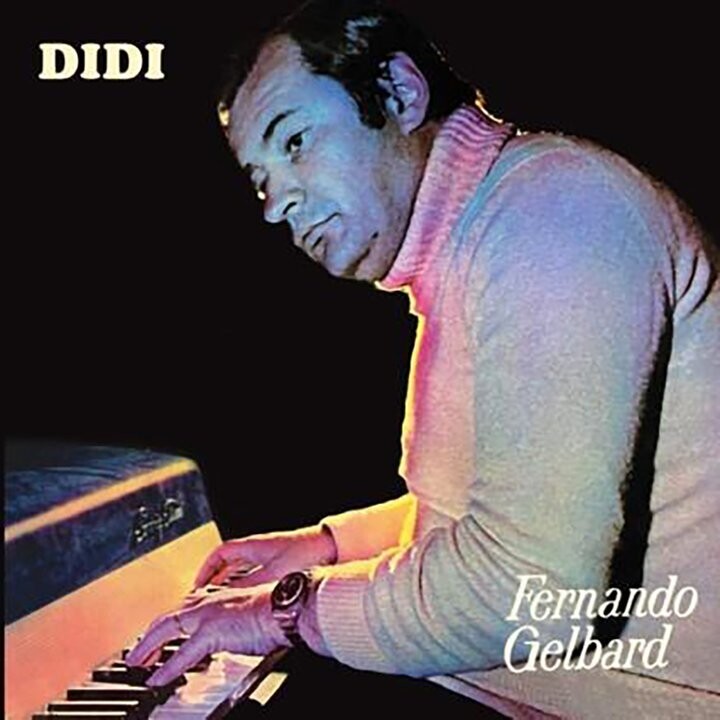
Buenos Aires, January 9 - The album 'Didi,' the only recording by pianist, composer, and producer Fernando Gelbard as a band-leader, is published for the first time in Argentina in CD format. Released by RP Music, the launch recovers a key work of local jazz recorded in 1974 and adds two bonus tracks, completing the international journey of the album, previously released on LP in the United Kingdom, Japan, and recently reissued on vinyl in Germany.
Originally edited by the Redondel label, 'Didi' holds a singular place within the discography of Argentine jazz. 'So I said to myself: 'I'm going to compose them all myself','' the musician recalled in an interview with the Argentine News Agency.
For the recording, Gelbard brought together colleagues and friends who defined the album's sound: Horacio 'Chivo' Borraro on tenor sax, Ricardo Salas on electric bass, Norberto Minichilo on drums, 'Chino' Rossi and Rubén Rada on percussion and vocals. In a scene dominated by standards and shared repertoire, the decision to create an entirely original program marked an artistic stance.
The album was recorded in a context as fertile as it was uncertain. In the early 1970s, Gelbard was an active part of the vibrant Buenos Aires scene, a regular at the 'jam sessions' (or 'pizzas' as they called them) held at Carlos Tarzia's house, a meeting point for the local jazz community with visits from international figures.
The musician noted that at the time he knew, as his father had been Minister of Economy under Perón, that if a military coup came, they would kill him or he would have to leave, so the album had to be released 'now or never.' The album is titled after his wife's nickname, to whom it is dedicated. It opens with 'Hola Didi,' a piece that serves as an intimate homage and aesthetic declaration.
Production was handled by Juan Carlos Maqueira and Alberto Tsalpakian, while Gelbard focused on composition and performance. 'With Negro Rada we were friends and I thought of calling him to record, because there's a formula that never fails: if you surround yourself with the best musicians, it's more likely that the album will turn out well,' he noted.
For the musician, the album remains relevant: 'The album synthesizes the sound of the seventies, a sound that is probably valid today.' Gelbard, who has been based in the United States for years, developed an extensive international career as a producer, arranger, and musician, working with figures such as Rob McConnell, Phil Woods, Enrico Rava, Miles Davis, and Henry Mancini, among many others. He also edited and recovered historical recordings of Argentine musicians abroad.
'Suddenly I would wake up in the middle of the night and start looking for sounds and ideas. It was pure inspiration, very difficult to explain,' he affirmed. The CD edition incorporates two bonus tracks: 'Havana Nights,' an improvisation and experiment by Gelbard, and an alternative mix of 'Alevacolariea,' a composition shared with Rada. The album also reflects the technological curiosity of the period: Gelbard used an electric piano and a Moog synthesizer—'probably one of the first if not the first in Argentina'—and developed part of the material from sound experimentation.
Although Gelbard was part of countless groups and participated in historical recordings and performances, this album was the only one in which he assumed the central role of composer and performer. 'So I went to the Music Hall studios, which had an eight-channel console, and that's where I recorded the album surrounded by a group of top-level musicians,' he recounted.
The arrival of 'Didi' on CD in the country not only completes its local circulation but also brings to the present a fundamental piece of the history of Argentine jazz.