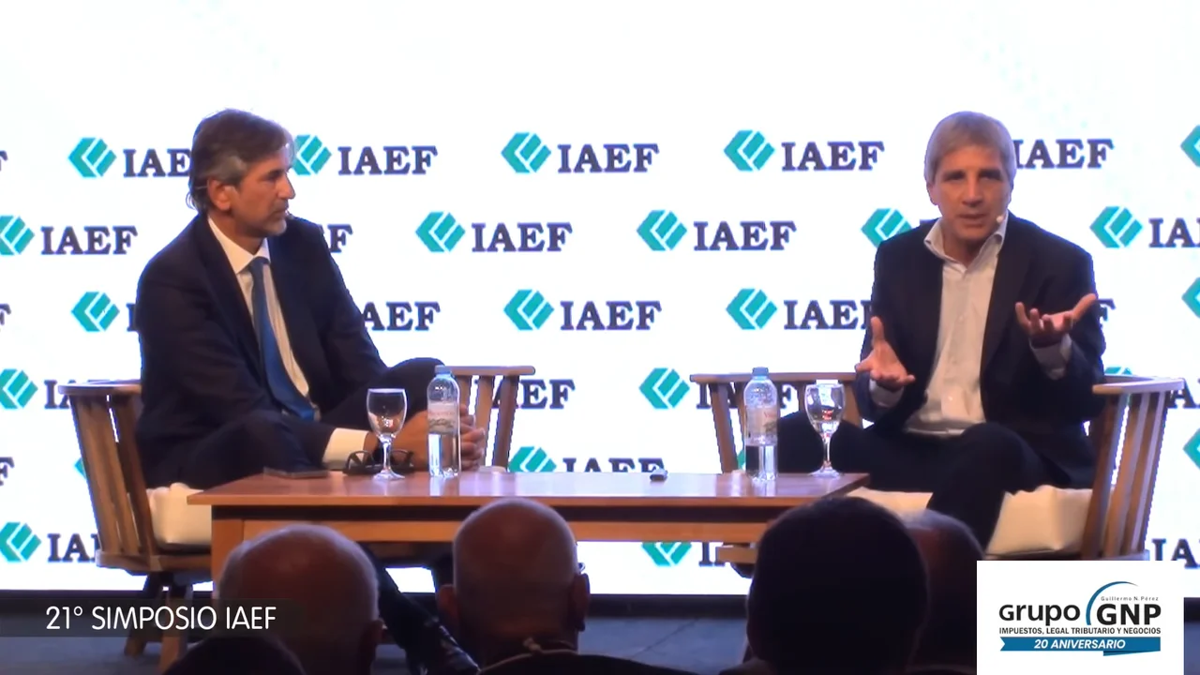
The Argentine government seeks to sustain the idea that macroeconomic stabilization has already begun to create concrete investment opportunities. The government attempts to establish that a phase of strong capital inflow is approaching, insists that the macroeconomic order is already consolidated, and strives to show that it can manage its external commitments without hastily returning to traditional debt. This combination of economic, ideological, and foreign policy message made it clear that the economic team seeks to frame the investment discussion not only in technical variables but also in a narrative of strategic alignments and institutional predictability. In financial matters, Caputo reiterated that the government does not foresee returning for now to international debt markets. In fact, in the days following that agenda, Caputo announced a US$ 500 million investment by Uber in Argentina over the next three years, after a meeting with the company's global CEO, Dara Khosrowshahi, and its local executive. The minister also took the opportunity to further contrast with the recent past and once again differentiate the current administration's economic program from the cycle of Mauricio Macri. According to his vision, the distinctive feature of the current government is having achieved macroeconomic order by political decision, without waiting for a crisis to impose an adjustment. This presentation was presented by the ruling party as a showcase to attract investments in energy, mining, infrastructure, and services. The organization limited itself to indicating that technical work continues and that conversations are advancing in close contact, a formulation that confirms that the dialogue is not broken, but also that there is not yet a closed definition. Thus, Caputo's presentation left a fairly complete picture of the economic and political moment the ruling coalition is going through. In this sense, he affirmed that the economic team already has identified financing sources to cover the next three capital maturities, corresponding to July of this year and January and July of 2027, for a total close to US$ 9,000 million. Buenos Aires, March 19, 2026 - Total News Agency - TNA - Luis Caputo once again this Thursday positioned himself as one of the main spokesmen for the government's economic optimism and assured that, after the recent Argentina Week in New York, a “phenomenal” investment scenario is looming for the country. In that segment, he harshly criticized the regimes of Iran and Venezuela and attacked communism, which he presented as a path already disproven by historical evidence. In this framework, the head of the Ministry of Economy chose to show confidence and stated that the process underway has no precedents for having been undertaken, as he said, by political decision and not as a consequence of a terminal crisis. In his review, the minister highlighted the impact of the Argentina Week organized in the United States, where he shared activities with investors, businessmen, officials, and Argentine governors. Because in an economy marked by accumulated distrust, announcements can be encouraging, although the true test always arrives when promised investments stop being expectations and begin to become facts. That reading was accompanied by a strong ideological charge: Caputo attacked kirchnerismo, which he defined as a force destined to become a “residual party,” and maintained that that space left a deep economic and psychological damage to society. He also allowed himself a high-voltage geopolitical definition by reaffirming Argentina's alignment with the United States and Israel in the Middle East conflict. As he described, there were praises for the economic course from the provincial leaders and a positive perception of the change in the country's image abroad. On the other hand, he needs to reaffirm that narrative in the face of signals that demand prudence, such as the persistence of country risk, the delay in the next IMF disbursement, and the recent acceleration of some price indicators. He assured that there is no a priori rejection of Wall Street, but a matter of costs, and maintained that today Argentina has cheaper alternatives. However, in parallel to that message, the IMF's spokesperson, Julie Kozack, avoided setting a date for the US$ 1,000 million disbursement that the government expects after the ongoing review. The official idea is to continue prioritizing lower-cost mechanisms while the international market does not offer more convenient conditions. Regarding the link with the IMF, the minister defined it as “spectacular” and assured that Argentina never had such a trusting relationship with the organization. But at the same time, he needs those promises to start translating into tangible results. Closing his participation in the 21st Capital Markets and Corporate Finance Symposium of the Argentine Institute of Executives of Finance (IAEF), the minister stated that “the fruits will begin to be seen in the short term” and spoke of a “boom that nobody imagines,” in an intervention where he mixed promises of capital inflow, a harsh verbal offensive against kirchnerismo, and new definitions on debt, markets, and the relationship with the IMF. Caputo's exposure came at a particularly sensitive moment for the Argentine economy.