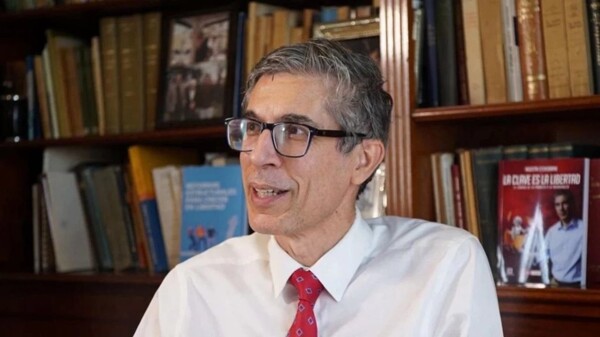
Economist Emmanuel Álvarez Agis warned that the reduction of inflation in Argentina faces structural limits and that the government of Javier Milei must balance the goal of price stabilization with the need to avoid a deep recession and the loss of quality jobs. The former Deputy Minister of Economy analyzed the February inflation data, which was 2.9%, the same figure as in January, and stated that the dynamic responds mainly to the loss of the exchange rate anchor within the current macroeconomic framework. 'When one looks at the trajectory of the exchange rate since the agreement with the Fund, except for the last two months, Argentina lost the exchange rate anchor as an anti-inflationary tool,' he explained. According to the economist, this change in the economic policy regime impacts the evolution of prices with lags. 'In economies with annual inflation rates of the order of 20% or 30%, it is normal for a movement in the exchange rate to have effects on inflation between six and twelve months later,' he stated on Splendid AM 990. In this context, he considered that the interruption in the downward trajectory of inflation responds to this exchange rate dynamic, to which are added specific factors such as the recomposition of tariffs and the increase in the price of meat. According to what Argentine News Agency learned, Álvarez Agis also warned about the impact of the international scenario, especially the increase in the price of oil due to geopolitical tensions. 'If the barrel stabilizes near 100 dollars, at the pump we could see increases of between 15% and 18%, which implies something more than half a point additional in the price index,' he noted. However, he stated that the same shock can also generate positive effects for the Argentine economy. 'Argentina is going to have more dollar income from oil exports. GDP grows, but it has drastically changed who wins and who loses,' he said. In this sense, he detailed that sectors linked to agriculture and energy registered expansions of up to 35%, while areas such as industry and construction show significant falls. 'The problem with this growth regime is that the winners are the dollar providers, which is positive in the medium term, but the losers are the large generators of quality jobs, which are the industrial sectors,' he warned. For the economist, the government faces a dilemma between accelerating disinflation or sustaining activity. 'Perhaps it would be healthier to recognize that the oil shock will put a pause in the decrease in inflation, because if we do not accept that pause, the sacrifice in terms of activity could be very large,' he proposed. The conflict in the Middle East drives up crude oil and reopens the debate on inflation. Regarding the commercial opening promoted by the current administration, Álvarez Agis indicated that although Argentina has historically been a closed economy, the current process is taking place with unusual speed. 'For the country's own standards, we are at one of the highest degrees of opening in our history,' he affirmed. However, he considered that the problem lies in the macroeconomic conditions in which this process occurs. 'You have a very high interest rate to sustain the exchange rate and lower inflation. For those who compete with the outside, it is a double pressure: lack of exchange rate competitiveness and very expensive credit to reconvert,' he explained. The economist also referred to the relationship between the government and the business sector. 'Businessmen maximize benefits subject to the restrictions or the absence of restrictions that economic policy imposes on them,' he stated, indicating that business behavior responds to the incentives set by the regulatory framework. Regarding the political scenario, Álvarez Agis warned that the electoral outlook is still uncertain. 'To say that the government has a clear path to re-election is too risky. And if we get there, it will be in the peace of the cemeteries, so it would not be advisable to try it either'.