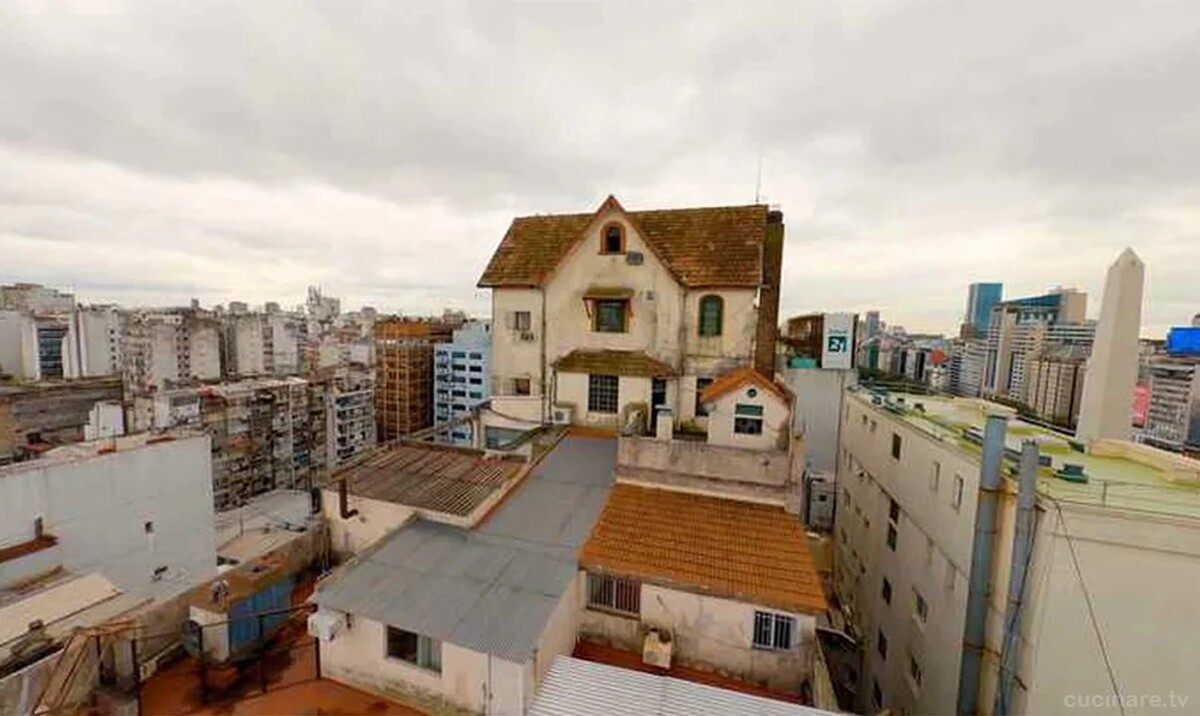
Buenos Aires, January 13, 2026 (NA) – The property, on whose terrace a two-story chalet with an attic was built—one of the most outstanding architectural landmarks in Buenos Aires: the Díaz chalet—has been put up for sale again. It is located at Sarmiento 1100, on the block surrounding the Obelisk. The real estate listing indicates it is a French-style building of over 10,300 square meters, of which around 7,500 m² are currently rentable office spaces, as confirmed by Noticias Argentinas agency. It has nine office floors, a basement, a ground floor with a commercial space, parking, and three elevators. The largest furniture store in South America used to operate there. Each of the 800-square-meter floors had a special section for a different type of clientele. On the terrace was “Radio Muebles Díaz,” a pioneer in marketing communications, with the antennas and frequency that would later become Radio Rivadavia. However, the Díaz chalet that tops the building breaks all canons, as it is inspired by the classic Mar del Plata architecture in a Norman style, with a tiled roof. Rafael Díaz, a Spanish immigrant and founder of Muebles Díaz, one of the most important furniture stores in Buenos Aires during much of the 20th century, had it built in 1927, when 9 de Julio Avenue had not yet been widened and it was nine years before the Obelisk existed. It has five environments, an attic, and two terraces: 200 square meters in total. It preserves much of its original elements, including pine floors, openings, windows, and period lighting fixtures. It was declared an Integral Part of the Cultural Heritage of the City of Buenos Aires, in the category of “Historical Sites or Places,” under the protection of Law 1227. Therefore, any project that the eventual buyers of the complex carry out will be subject to that historical status and must comply with the current regulations on accessibility, security, and fire prevention. Thus, no structural modifications can be made without authorization from the Culture area. For almost its entire history, the Díaz chalet was reserved exclusively for family gatherings, thus maintaining its mystery in the popular imagination. Few privileged people were able to go up before it was opened to the public, such as photographers and the group Almendra, by Luis Alberto Spinetta, in the 70s. Who was Rafael Díaz? He arrived from Spain at 14 years old, only with his mom.