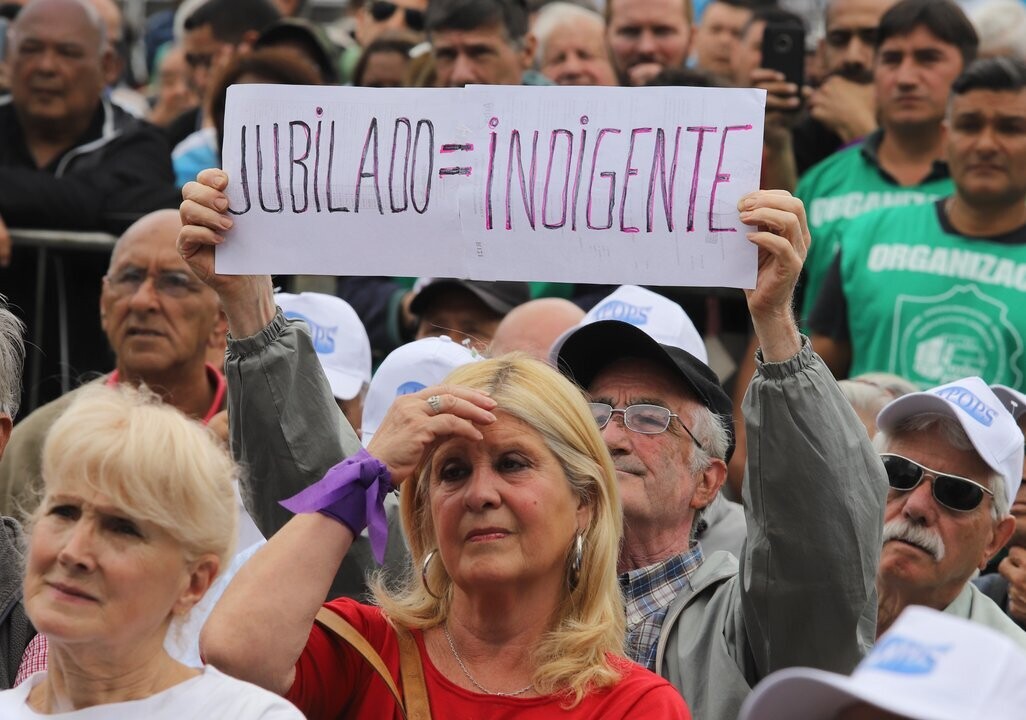
Buenos Aires, January 12 (NA) – Those who receive the child allowance closed 2025 with a purchasing power equivalent to almost double what they had in November 2023. Their purchasing power ended up 67% higher than in 2023, becoming the population sector that increased real income the most in the last two years. In 2024, they had a real increase of 47%. Thus, they became the population sector that increased real income the most in the last two years, according to a report from the IARAF institute, which had access to the Argentine News Agency. Meanwhile, due to the increase in public services, the middle class was one of the social sectors that lost the most purchasing power since President Javier Milei took office in December 2023. National and provincial public sector workers, and retirees who receive the minimum benefit, lost purchasing power in a scenario where inflation did not let up in 2024 and remained at high levels in 2024. Registered private sector workers closed last year at the same level as two years prior. The only improvement the government was careful not to neglect in these two years was the child allowance, whose beneficiaries improved their purchasing power. In this scenario, registered private sector workers had a purchasing power practically equal to that of November 2023. As for national public sector workers, they lost 33%. In the case of provincial public sector workers, after an initial significant drop, they finished 2025 with a real income loss of 6.5%, always compared to November 2023. Additionally, retirees who receive only the benefit (without a bonus), at the end of 2025, achieved a real increase of 9.3%. In turn, retirees who receive the minimum benefit and the bonus, concluded 2025 with a loss of 7.5%. If the analysis is made with annual incomes, comparing all of 2025 with 2023, registered private sector workers had a 1.5% lower annual purchasing power than in 2023, after having a 6.1% drop between 2023 and 2024. Meanwhile, national public sector workers had a 33% loss, almost the same as the monthly comparison between November 2023 and December 2025. In 2024, they had lost 27% compared to 2023. Salary spending is one of the areas the national government continued to cut in 2025, so that, given the fiscal constraint, the increase in retirement benefits and AUH, among others, could be financed. In the case of provincial public sector workers: the real annual income loss is 11%. For retirees who receive only the benefit, the real annual loss was 9%, when in 2024 they had lost 19%. And in the case of retirees who receive the minimum benefit and the bonus, the annual loss was 13.8%. Of the six population groups analyzed, when the comparative analysis is made between the real annual incomes of 2023 and 2025, five lost purchasing power and only one improved, which is the case of AUH recipients. National public sector workers are the sector that registered the greatest loss of purchasing power in 2025 compared to 2024.