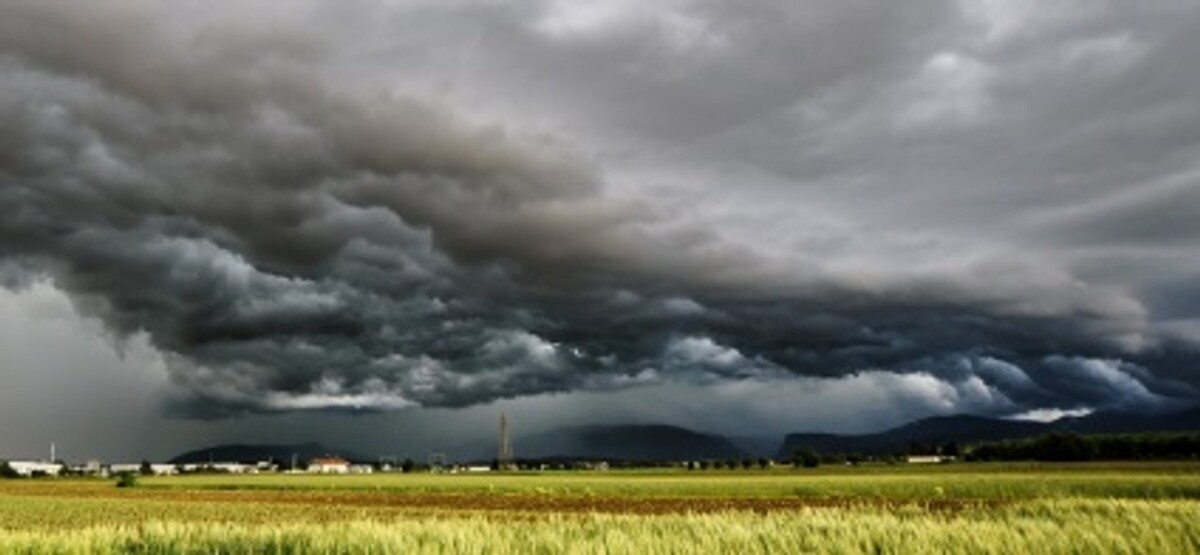
Buenos Aires, December 13, 2025 (NA) – The second half of the month begins with unstable weather, featuring erratic and insignificant rainfall, "whose water supply will depend directly on the level of available atmospheric humidity," says environmental consultant Javier Elorriaga. Over the weekend, a new cold front will advance through the central part of the country, which will significantly alter atmospheric behavior, the Argentine News Agency reported. On Saturday, the front will be positioned over the central strip of the country and will begin to activate rains, showers, and storms of varying intensity in the north-central Buenos Aires, northern La Pampa, and southern Córdoba areas. This first advance will mark the beginning of a more dynamic period, with an atmosphere that will shift from limited phenomena to more organized events. Cold Front The entry of the cold front will create a marked thermal contrast between warm air masses to the north and milder ones to the south. It constitutes an additional source of energy that will favor the development of more structured storms, capable of moving in stripes and covering larger areas. The spring that is ending has been like no other. With very good rains and recharged soil profiles, it was ideal for sowing and applying crop technology. Soil maps show varied environments, some with excess water, others with deficits, but most are very well supplied. Amount of Water The report from the Rosario Exchange is very optimistic about the amount of water available to the crops. Wheat is set to mark a milestone that will be difficult to repeat. However, if significant rain does not fall this weekend, the first plots that have already entered the critical period will feel the impact and lose their potential," warn from Bigand, a diagnosis that is replicated in Marcos Juárez. In contrast, from the Venado Tuerto area, they report that they see no signs of stress even during peak hours. "The corn, for now, is holding up well." They suffer during the day due to low relative humidity, but they recover wonderfully in the late afternoon and at night. For now, they are coping with the lack of water. With 80% of the harvest, the campaign averages 60 qq/ha. Based on satellite analysis, a larger area was determined: the core region reached 1.82 M ha. Exceeding 40 quintales as an average for wheat is very difficult because it may do well in good plots, but bad fields pull the number down a lot. But in this campaign, the bad fields have surpassed 50 to 55 qq/ha," explain technicians from Córdoba. That is why, the master key that unlocked these "unthinkable" numbers was the water that accompanied the crop throughout the entire cycle. Exceptional Hydrological Scenario The campaign was sustained on an exceptional hydrological scenario. The May rains were very important: with accumulations above the average, they left 80% of the region with adequate to excessive moisture reserves, especially in the northeast of Buenos Aires. In some sectors, excess water hampered the initial sowing. But thanks to the only deficit month, June, it was possible to complete the sowing intention in those areas. In the rest of the region, the profiles still retained sufficient moisture to complete implantation without setbacks. By early July, 90% of the regional wheat was already sown. And in August, the unprecedented happened: it rained almost 8 times more than the average. From then on, the rains surpassed the historical average values. The August rains were decisive: the excesses saturated the soils in 83% of the area and boosted tillering, and at that time, farmers were already projecting yields close to 60 qq/ha, but they did not imagine they would exceed 100 qq ceilings. The rains from September and October ensured that the crop went through its critical stage, while the November rains guaranteed optimal grain filling. Second-Crop Soybean Sowing already covers 70% of the area for second-crop soybean. After the wheat harvest, it was expected to cover 1.82 million hectares with second-crop soybean. Of that total, 1.3 million are already planted. The most delayed sector is the north of Buenos Aires, where wheat harvesting started later. As for the quality of the sowing, they agree that the moisture is very good, and despite the large amount of stubble left by wheat, there are no major complications. "As long as you don't try to enter with the soil too wet, with these warmer days and without significant rain, on a well-aerated soil, the seeders advance perfectly." Early Corn From very good to excellent: early corn is holding up, but it needs water so that its potential does not decline. With half of the early corn in full flowering and another 45% in tasseling, the technicians agree: 90% of the crop is in very good to excellent condition. But they also warn that there are areas where a rain is becoming more than necessary right now, as the crop defines its yield. "The corns are fine."