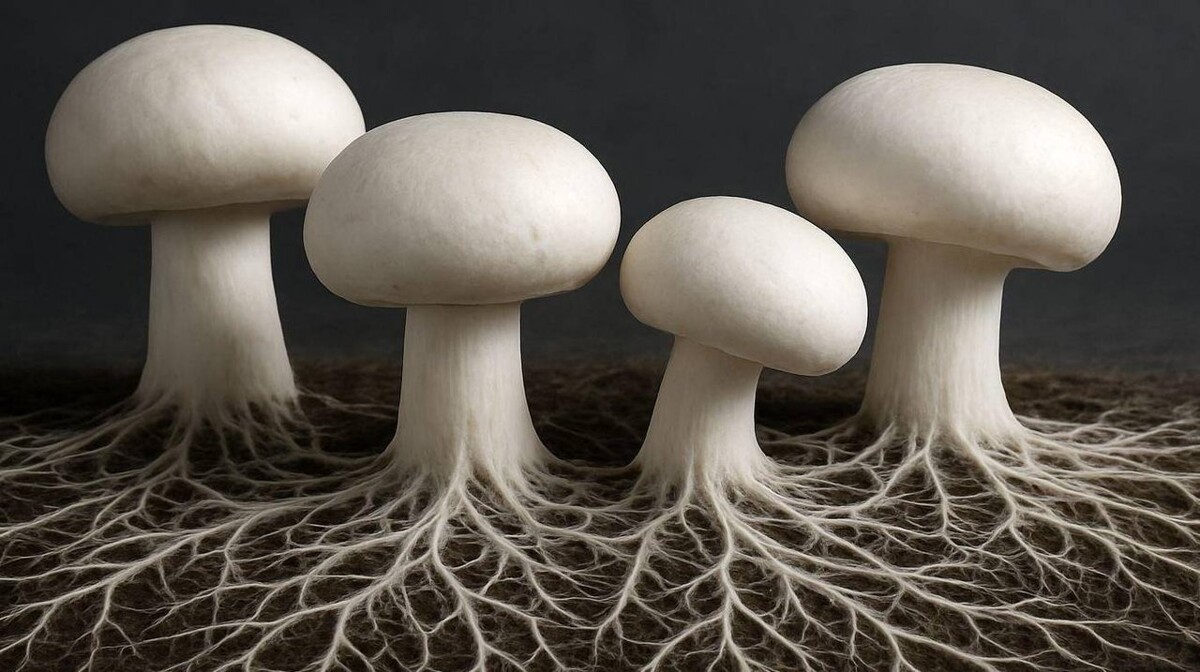
The world of fungi has become one of the most fascinating trends in contemporary biotechnology, with its applications ranging from medicine to fashion, architecture, and industrial design. In this ecosystem, mycelium is positioned as a key player in a sustainable future due to its ability to synthesize complex molecules and transform waste into useful materials. Meanwhile, globally, Europe and the United States are promoting policies that foster regenerative materials—those that not only reduce their impact but also add nutrients to the soil and regenerate the environment.
Approximately 380 million tons of plastic are produced annually, and despite the actions of governments, companies, NGOs, and global public awareness, it is impossible to avoid its dramatic impact on the ecosystem.
With her company, Pañella seeks to solve one of the most absurd paradoxes of modern production: that a product's packaging lasts longer than the product itself. "When we create an object, its function, aesthetics, and environmental impact are thought of as a single system, not as separate decisions," she explains.
How the packaging is cultivated The process behind the material is as innovative as it is organic. Mycelium is fed by recycled agricultural waste from local producers. This mixture is placed in molds where, under controlled conditions, the fungus grows to form a firm and completely biodegradable matrix. Once it reaches the desired shape, the material is dried, stopping its growth and giving rise to a rigid, lightweight, thermally insulating, hydrophobic, and plastic-free object.
Mycelium, which is the heart of our work, forces us to look at everything in a more organic way: the material has its own logic, its own time, its own language. Hence, it can be an eco-friendly alternative to replace polystyrene and other materials that, even if they are biodegradable, leave toxic residues, such as microplastics. While most single-use packaging takes centuries to disappear, the developed material naturally reintegrates into the soil in just 45 to 60 days.
"We are here to solve a contradiction of the industrial era: that a disposable wrapper lasts longer than the object it protects," states the designer.
"Mycelium has enormous potential: we are just beginning to explore everything it can do. Its applications go far beyond packaging; it is a living material with possibilities in multiple industries," she concludes.