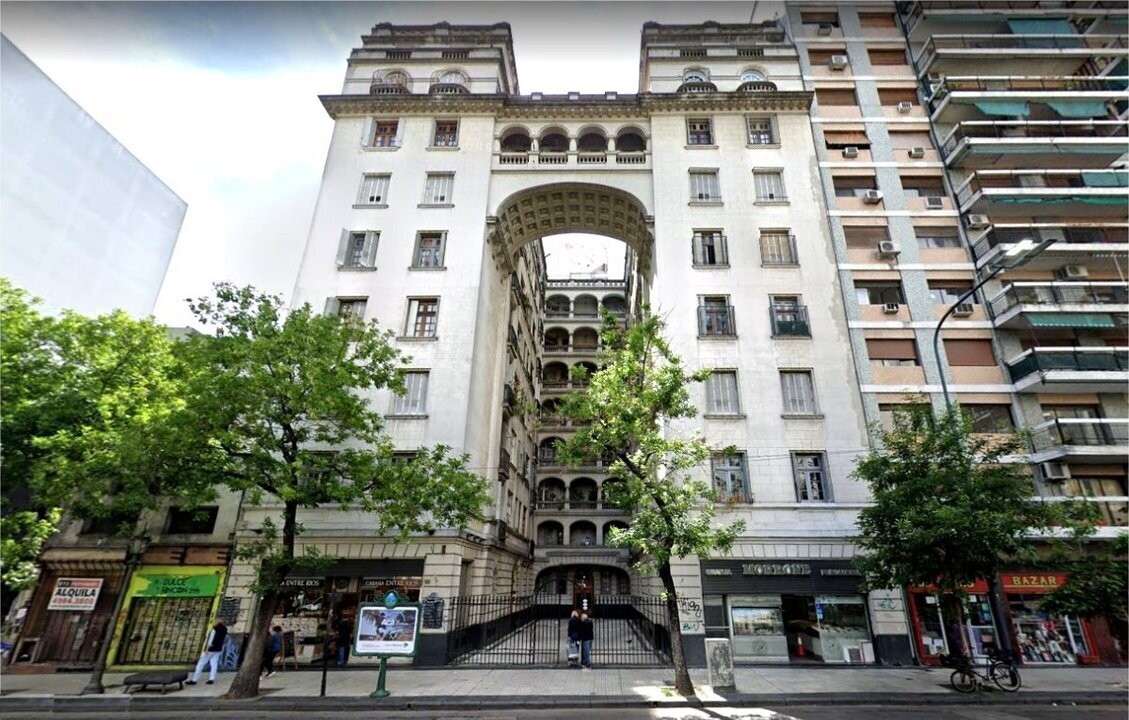
In Buenos Aires, on Avenida Entre Ríos, between numbers 958 and 974, an imposing concrete block rises with a monumental arch crowning its structure and giving it its name: the Edificio del Arco. Built between 1928 and 1930 by Spanish architect Guillermo Álvarez Pérez, this building is one of the most curious pieces of residential architecture in Buenos Aires and is included in the catalog of properties protected by the Legislature under Law 851.
The design reflects a functionalist criterion that mirrors the social and urban transformations of Buenos Aires in the early 20th century. In a context of demographic expansion and rapid modernization, the city adopted new typologies such as rental houses, which integrated technical innovation and practical sense without renouncing ornamentation. Álvarez Pérez, also author of the famous Torre del Fantasma in La Boca, combined in this work a modern perspective with an evident fascination for classical forms.
The result is a building that seems to defy any classification: a rental house that mixes academicism, Renaissance, and Mannerism, with a unique language that oscillates between the monumental and the domestic. The complex is organized in three bodies of eight floors and 54 functional units, with a single main entrance delimited by an artistic wrought-iron gate with spear points. However, despite its 'bridge-like' appearance, the arch does not connect the side bodies, but houses independent rooms.
Its eclectic aesthetic, far from going out of style, turned it into a heritage piece that synthesizes a key stage of Argentine architecture: the search for a style of its own amidst the vertigo of progress. Almost a century after its construction, the Edificio del Arco is still a fascinating rarity. Between the evocation of the European past and modern functionality, its monumental arch—more symbolic than structural—seems to continue celebrating, in the full 21st century, the victory of design over monotony.
The interiors maintain their original character. The floors are of Slavonian oak and pinotea, the interior doors feature divided glass, and the moldings of the entrance hall preserve the refinement of middle-class homes from the thirties. Today, several of its apartments are offered for sale or rent, and its silhouette continues to stand out among neighboring buildings. The half-point wooden doors and divided glass windows complete an air of era that survives the contemporary vertigo.
The arch that distinguishes the building, visible from several blocks, is not a simple ornament: it constitutes the crowning of the sixth floor and is flanked by two half-point balconies that open onto the street. The facades that face the courtyard preserve a granite frieze, cushioned with horizontal lines and a cornice that elegantly cuts the volume. On the terrace, arranged in a 'U', there are small mirrored apartments and a common solarium, while the ground floor premises, now recycled, recall the intense commercial activity of the avenue.
In a time when the area was a vital corridor between Monserrat, San Cristóbal, and Constitución, the avenue—until 1922 called De las Tunas—combined mansions, cafes, unions, and bustling businesses. Behind it, a distributor patio of ample dimensions opens, from where the different sectors of the building are accessed.