Buenos Aires, November 25 (NA) -- Businesspeople and former officials from Kirchnerist governments raised their objections to the trade agreement with the United States in the Chamber of Deputies on Tuesday, as the government has not yet sent the agreement to the National Congress.
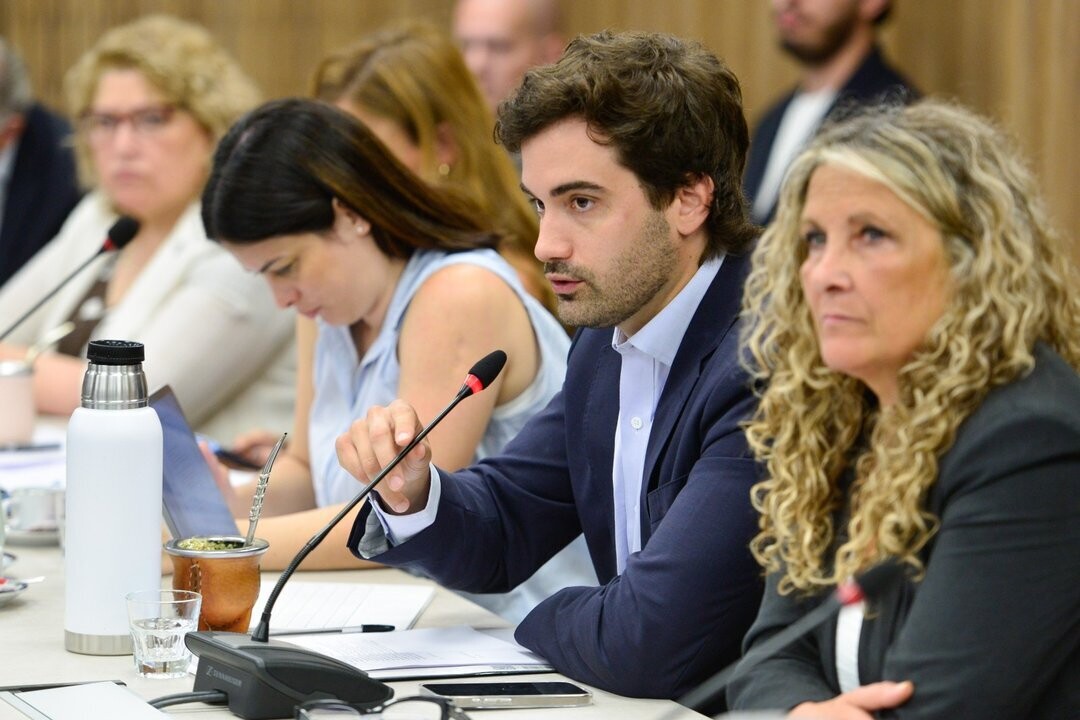
The agreement signed between Argentina and the United States was debated in the Chamber of Deputies' Trade Committee, chaired by the 'Campero' Tomas Ledesma, where criticisms of the agreement were voiced for not being beneficial to the country and potentially adding a new point of tension within Mercosur.
At the start of the meeting, Ledesma again demanded that the government send the trade agreement to Congress for study, as it deals with tariff and customs matters that require "parliamentary approval."
The commission's informational meeting was mostly attended by deputies from Union for the Homeland (UxP), but most libertarians were absent, with only Santiago Pauli attending.
The government announced a framework agreement with the United States but has not sent any details of the agreement to Congress, as learned from the Noticias Argentinas news agency.
Speakers
The first speaker was José Tamboronea, president of ADIMRA's Industrial Policy Committee, who expressed his concerns about the potential impact of the agreement on Argentina's industry.
"The way this agreement is structured, it will be difficult to achieve the virtuous results that might be possible when one looks at the production of both countries and the opportunities that are opening up with the geopolitical changes taking place at this moment," he added.
Former Atomic Energy Commission official Natalia Stankevicius objected to the agreement, arguing that it "undermines" the country's sovereignty due to the "role and strategic character of the nuclear sector in Argentina."
She added that the "country needs dollars and that uranium exports could be a business portfolio."
"In the trade exchange, the agricultural sector is more important for us than for them." Meanwhile, former Undersecretary of Political Coordination of the Ministry of Agriculture, Livestock and Fisheries, Ariel Martínez, pointed out that "we are sure that this creates a tension with Mercosur, which is a stable relationship of Argentina with its partners."
He stated that "Mercosur has many flaws to solve, but it seems to be the best place to be and project oneself, being a place that institutionally contains our countries and gives a much more powerful framework and negotiation backing than doing it individually."
"We are two more competitive than complementary countries, doing the same things as the United States, but on a scale ten times smaller, without having railway infrastructure, waterways, roads, or in terms of technology either," he pointed out.
In this context, he said that "we are concerned about the preferential access that Argentina would be granting to the US market for goods that include medicines, chemicals, machinery, information technology products and medical devices, motor vehicles, and a wide range of agricultural machinery."
Former Undersecretary of International Affairs during the Kirchnerism, Martín Schapiro, criticized that they are "discussing an announcement made by the White House before Argentina," and questioned the benefits that this agreement could bring to our country.
"But the problem is what penalties we are imposing on future generations, because here we are discussing base energy," he stated.
Meanwhile, former Undersecretary of Agri-food Markets, Javier Patiño, assured that the agreement must be well analyzed since "of all exports to the United States, 21% is agricultural, while of what we import from the United States only 1.6% is agricultural."