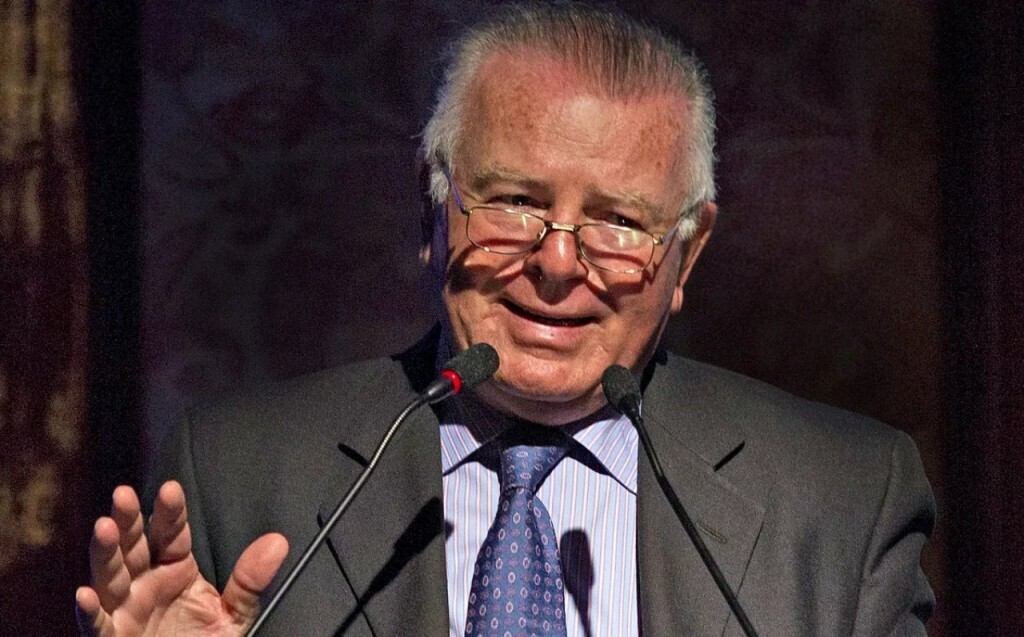
Economist Orlando Ferreres analyzed doubts regarding a new international credit with various US banks and stated that it «will not be more than US$5,000 million». According to what Argentine News Agency (Agencia Noticias Argentinas) learned from his statements on Radio Rivadavia, the economist referred to the reduction of a credit for Argentina from US$20,000 million to US$5,000 million, indicating that although the amount is smaller, it is still «quite a lot of money». Minister of Economy Luis Caputo affirmed a few days ago that it was «just another operation» aimed at «generating confusion». Additionally, he referred to the pension reform, pointing out the possibility that «AFJPs (Administradoras de Fondos de Jubilaciones y Pensiones) may return in the future». Inflation projections for 2025 and 2026 Addressing the topic of inflation, Ferreres provided concrete figures. He indicated that recent retail measurements were below 2%, but the Consumer Price Index (CPI) has been above 2% for the last three months. For November, he estimates it will not exceed 2%, but for December he anticipates an increase due to basic services and beef. The economist projected a year-end inflation rate for 2025 between 29% and 30%. And he estimated that for 2026, inflation could be between 14% and 15% annually. He recalled the periods of «massive investment environment» during the convertibility, with large privatizations, and lamented that currently there is «not much to do in terms of privatizations». Ferreres suggested that the «tranquility» generated by the October 2025 elections, where La Libertad Avanza (LLA) won by a wide margin, could favor an investment environment. Structural reforms on the horizon Ferreres also referred to the labor and tax reforms that the Government seeks to approve in Congress during extraordinary sessions. The official stated that the figure of US$20,000 million was never discussed. In response, Ferreres indicated that the change is due to the «doubts» of the banks participating in the negotiation between the US government and Argentina regarding the guarantees the country can offer. The founder of the consulting firm OJF & Asociados also pointed out that the Government «let the exchange rate go up a bit,» with the official rate rising to $1,450, and has tried to lower the reference interest rate from 22% to 20%. International credit and financial challenges Ferreres explained that the banks' concern lies in Argentina's «lack of solid guarantees». Most of the country's reserves are lent by China, the United States, or the International Monetary Fund (IMF), which reduces «net own reserves». Likewise, with a measured but concerned tone, he noted that the country risk premium does not fall below 600 points when it would be ideal to reach 400 units to «generate greater confidence» in the markets. In this sense, he compared this situation with that of the City of Buenos Aires, which obtained US$500 million at 7.78% by offering robust guarantees. Another factor that generates «problems in Argentina» for the banks is the increase in debt delinquency, especially in credit cards and personal loans. For Ferreres, the «minimum effective reserves are too high to keep peso liquidity calm,» which, according to the economist, «must be lowered to foster investments». Investments and perspectives for economic activity Regarding investment, the economist indicated that while gross fixed domestic investment has improved from 13%-14% to 19% of GDP, this is more due to amortization than to massive new investments. He stressed the need for a broader investment program to generate employment and improve real wages. For Ferreres, the loan with US banks «is still quite a lot of money». With a tone that mixes realism and a pinch of cautious optimism, Ferreres recognized that 2025, which began with «a lot of optimism» in the private sector, ended «deflating brutally» and with a «very heterogeneous» level of activity. However, he projects an improvement for the coming year, linked to lower interest rates and greater liquidity. Nevertheless, he warned that even with those figures, Argentina is «after Venezuela» in the Latin American inflation ranking, since most countries have «4% or 5%». He expressed his desire for inflation to drop «quite a bit» and that by 2027 an annual figure of «a single digit» is reached, in line with the objectives of a government seeking re-election. Finally, Ferreres stressed that what is really lacking is GDP growth, for which investment is required. He mentioned that there are «calls from people interested in seeing what investments are made» and that they are informed that, although there are problems, «it's okay, things are improving a lot and things are going well,» but that «a little time is needed for the government to implement it». Confidently, he affirmed that «this time it is going to work out». He argued that unionism «has less power and is more diminished» than in other eras and highlighted the importance of a more flexible labor law, mentioning that in Uruguay the compensation is only «five or six months,» unlike Argentina. Regarding the tax reform, the economist showed his support for a single tax and criticized the Gross Income Tax (IIBB), which represents «12% or 15% of total revenue» and is repeated in each transaction. Also the expectation that the governors, through intermediation with the National Government, will accept «new formulas» to regularize this situation.