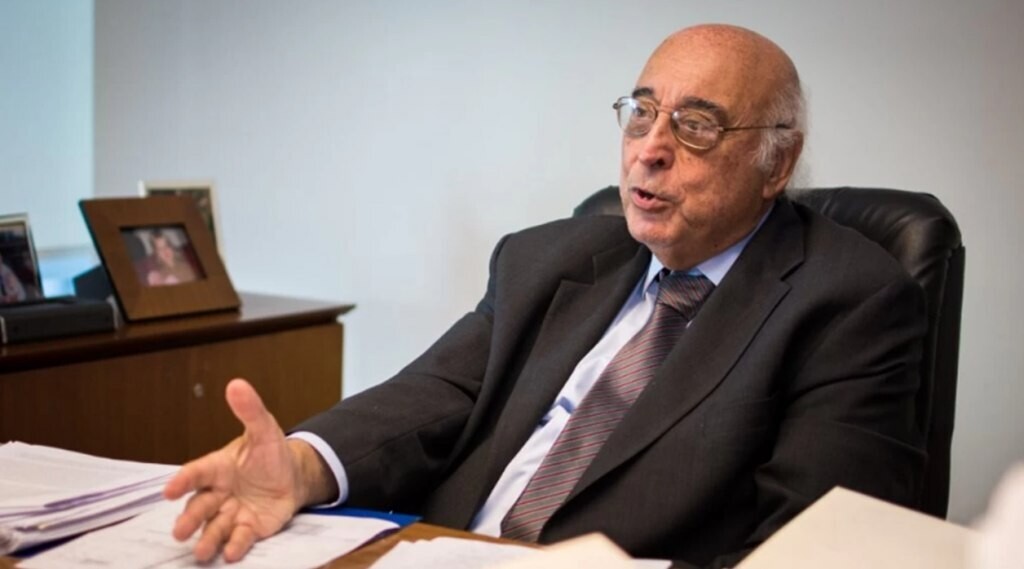
Economist Miguel Ángel Broda stated today that Argentina is facing a 'unique opportunity' to 'emerge from a long period of decline,' which he considered 'a scenario I have only witnessed twice in my professional career,' and stressed the need to accumulate reserves.
According to the Argentine News Agency (NA), which learned of his statements to Radio Rivadavia, Broda maintained that when analyzing theories of economic growth and the country's current situation, 'it is very difficult not to be optimistic' if certain fundamental conditions for economic development are met. However, he warned that this promising scenario is not without risks, emphasizing that macroeconomic stability 'is by no means guaranteed.'
The economist emphasized the need to transition from a closed, corporatist economy to an open, competitive, and free one, although there are still 'many pending tasks' to ensure a sustainable growth path.
Broda explained that the success of economic growth, which is the ultimate goal of the economy, basically comes from having inclusive institutions. He also added the renewed interest of U.S. foreign policy in Latin America, positioning Argentina as a key interlocutor for new investments with innovative technology.
Nevertheless, he warned that the country still has 'many pending tasks to ensure macroeconomic stability,' and pointed to cases like Tierra del Fuego, indicating the existence of errors and aspects he dislikes, such as the lack of importance given to the role of human capital to increase productivity.
In his analysis, the economist was critical of some of the government's economic decisions. He underlined the need for a 'simple' monetary policy that avoids the 'madness of real interest rates' and for the increase in money demand to be supplied with credit to the private sector, not with primary expansion.
In addition, he emphasized the urgency of 'accumulating reserves' and the need to dynamize a real sector that he considers 'very punished' and 'stagnant since February.'
Broda rejected the idea of using the exchange rate as a tool to lower inflation: 'It is not appropriate to use the exchange rate as the instrument to lower the inflation rate. It has not given results anywhere,' he stated.
He also proposed moving towards a managed float of the peso, with a Central Bank (BCRA) that has reserves to intervene when necessary, avoiding 'more innovation' and, instead, 'copying' successful models from other countries.
He estimated an equilibrium exchange rate between $1,650 and $1,700, stating that this should not 'frighten us so much.'
Regarding the President and the path to development
When referring to President Javier Milei, Broda recognized that 'for the first time in history' Argentina has a president 'who understands the sources of growth.' However, he identified a lack of 'a team of 100' for state management, an institution he considered 'absolutely necessary to grow,' although it had been 'oversized.'
He also highlighted that making a 'normal country' will take '20 years' and will require tax, labor, revenue-sharing, and pension reforms.
Despite the difficulties, he expressed an 'optimistic' outlook with a 50% to 60% probability that Argentina will manage to emerge from '100 years of decline,' although he clarified that 'by no means are we on a sure path.'
In parallel, Broda recalled his past with Milei at his consultancy firm (Estudio Económico-Financiero M. A. M. Broda y Asociados), praising his intelligence but noting that at that time it was difficult for him to 'make the leap' from theory to practice to 'understand the crazy economy of Argentina.'